Last updated November 18, 2026
DIY vs Professional New Detached ADU: What’s Safe to Do Yourself
Nevada’s owner-builder statute lets you pull your own permit for a new detached ADU in Henderson. It also requires you to disclose that you built as an owner-builder to any buyer within ten years of completion. Plenty of homeowners find that clause for the first time during escrow, when a real estate attorney on the other side of the table flags it and the conversation turns from “how much did you save?” to “how much is this going to cost me at closing?” The DIY question on a detached ADU in Henderson isn’t really about whether you can frame a wall. It’s about who signs the permit, who carries the liability, and what that signature means a decade later. This guide walks through the owner-builder election, the scopes that stay legal for a homeowner and the ones that don’t, the honest cost math, and the three areas where doing it yourself compounds.
Quick Answer
On a new detached ADU in Henderson, the legally DIY-able scope is limited to construction labor and project management under an owner-builder permit. You cannot legally perform electrical, plumbing, or HVAC work yourself regardless of who pulled the permit; those trades require a licensed Nevada contractor. You also cannot avoid the design side: stamped architectural and structural drawings, a Title 24 energy report, and a complete submittal to Clark County are required on every detached ADU, and those require licensed design professionals. The owner-builder election also triggers a ten-year disclosure obligation when you sell.
Table of Contents
- What Nevada’s Owner-Builder Election Actually Says
- The Ten-Year Disclosure Requirement and What It Means at Resale
- Which Scopes Are Legally DIY in Henderson vs. Licensed-Only
- The Permit Set Problem: Why Owner-Builder Still Needs Professionals
- Owner-Builder vs. Licensed GC: The Honest Cost Comparison
- The Three Scopes Where DIY Compounds Liability
- Henderson-Specific Conditions That Affect the DIY Decision
What Nevada’s Owner-Builder Election Actually Says
When you pull a building permit in Henderson without a licensed general contractor attached, you sign an owner-builder affidavit. The affidavit is a sworn declaration that you, the property owner, will perform or supervise the work yourself, that the structure is for your own use and not for sale or lease as a commercial venture, and that you understand the state’s requirements for owner-builders. It gets notarized. It goes into the permit file at Clark County. It does not disappear when the project is done.
The part most homeowners miss is what “supervise” means in practice. Nevada does not require that you personally swing a hammer. It requires that you are the responsible party of record, the person the inspector calls when something fails, and the person who fields the legal exposure if a defect surfaces later. That’s a clean line and it has nothing to do with whether you know how to install a subfloor.
The affidavit also creates a documented paper trail. Every failed inspection, every correction notice, every re-inspection fee during construction is attached to your name as owner-builder, not a contractor’s license number. On a resale, that file is discoverable.
For comparison, when we pull a permit as a licensed design-build studio, the affidavit is not part of the record because the licensed contractor is the responsible party. The permit file lists a license number. The liability sits with the licensed entity and the warranty that followed the work. A new detached ADU in Henderson built under a licensed general contractor’s permit is a fundamentally different legal artifact than one built under an owner-builder affidavit.
The Ten-Year Disclosure Requirement and What It Means at Resale
Nevada law requires an owner-builder to disclose that status in writing to any subsequent buyer for a period of ten years from the date of completion. Not five. Not “if asked.” Ten. The disclosure rides with the property through the first sale, and if that buyer sells within the window, the obligation follows the property again.
What that actually looks like at the closing table:
- The buyer’s agent pulls the permit history and sees the owner-builder affidavit in the file.
- The buyer’s attorney asks for the construction record: inspection reports, engineering letters, the as-built drawings.
- The lender’s appraiser flags owner-built structures for additional documentation, especially on FHA and VA loans where owner-builder construction draws extra scrutiny.
- The disclosure gets negotiated. Sometimes it costs a credit. Sometimes it kills the deal. On Henderson properties where the ADU is part of the rental income story, the buyer is underwriting that income stream, and an owner-built ADU with no warranty and no licensed construction record reduces what they’ll finance.
Compare that to a licensed contractor’s ADU: the permit record shows a license number, the warranty is in writing, the photo record exists, and the buyer’s attorney has nothing unusual to flag. Under The Haven Standard, every Ellery project produces a documented photo record of what was found and what was done, and a written warranty backed by the 365-Day Done Right Promise. Those documents are exactly what a buyer’s attorney asks for and, on an owner-built ADU, exactly what usually isn’t there.
Which Scopes Are Legally DIY in Henderson vs. Licensed-Only
Here’s where the owner-builder election gets misused. Some homeowners read “owner-builder” and assume it means “owner can do everything.” That’s not what the statute says, and Clark County inspectors enforce the line on every rough inspection.
Legally DIY-able under an owner-builder permit in Henderson:
- Site clearing, grading, and excavation (with engineering oversight on anything that touches neighboring grade)
- Footing formwork and steel placement
- Foundation waterproofing and drain tile
- Framing, sheathing, and rough carpentry
- Roofing and weather barrier
- Insulation installation
- Drywall, interior trim, and finish carpentry
- Exterior siding (James Hardie fiber cement is the most common spec in Henderson’s climate, and DIY installation is within range for a careful homeowner with the manufacturer’s install guide)
- Flooring, tile, paint, and cabinetry
- Landscaping and hardscape outside the building envelope
Licensed-only in Nevada regardless of who pulled the permit:
- Electrical – all branch circuits, panel work, service entrance, and final connections; a Nevada-licensed electrician must pull the electrical permit and sign the inspection
- Plumbing – supply, drain, waste, vent, and gas piping; licensed plumber required
- HVAC – refrigerant lines, ducting, and the mechanical permit itself; licensed contractor required
- Solar photovoltaics – licensed electrician, separate permit
- Any structural engineering stamp – must come from a Nevada-licensed engineer
So the “DIY” path on a detached ADU in Henderson is really a hybrid: you are the general contractor of record, and you still hire three licensed subs for the MEP trades. That’s a legal and workable structure. It’s also more project management than most homeowners expect on a build that typically runs six to nine months.
The Permit Set Problem: Why Owner-Builder Still Needs Professionals
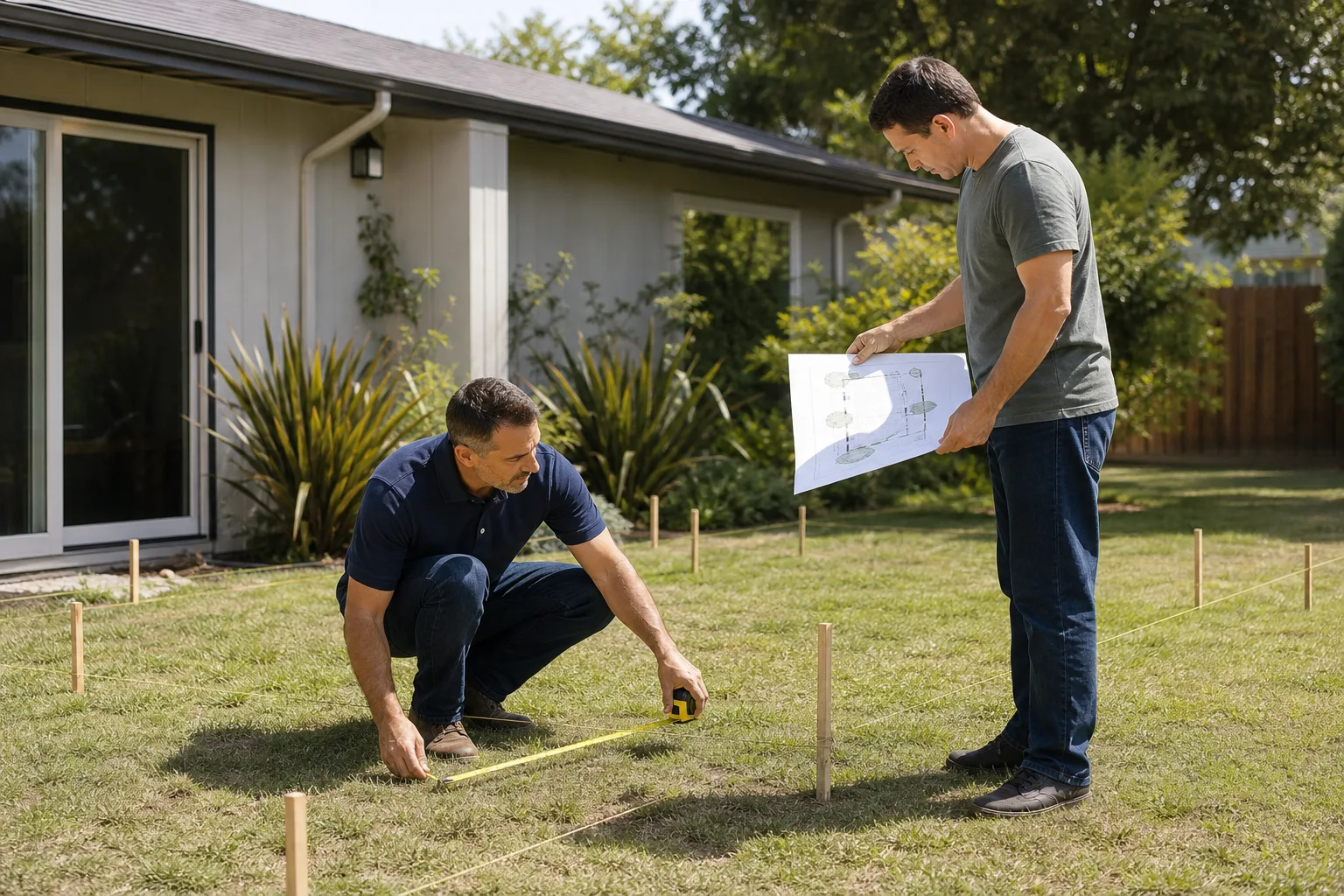
This is the piece that catches owner-builders off guard, and it’s not close. Pulling the permit as owner-builder does not exempt you from any submission requirement. Every new detached ADU in Henderson requires:
- Stamped architectural drawings showing floor plan, elevations, sections, and site plan with setbacks, finished floor elevation, and grading. These must be prepared and stamped by a Nevada-licensed architect or engineer.
- Stamped structural drawings including foundation plan, framing plan, shear wall schedule, and hold-down details. Also requires a licensed engineer’s stamp.
- A Title 24 energy compliance report prepared by a certified energy consultant, showing the building envelope, glazing, insulation values, and HVAC system meet the current energy code.
- A complete submittal package including site plan, utility plan, grading plan, engineering calculations, and the Title 24 report, assembled and formatted as Clark County’s submittal checklist requires.
Design cost on a Henderson detached ADU typically runs $18,000 – $32,000 depending on complexity, lot conditions, and structural requirements. That number exists whether you build the ADU yourself or hire a licensed general contractor. You cannot diy your way around it by signing an owner-builder affidavit, and we’ve watched more than a few homeowners spend a season discovering that.
We treat the permit set as the core deliverable, not a checkbox. It’s the reason our ADU design and permitting in Henderson is a named scope rather than an afterthought layered on top of construction, and it’s the reason the drawings in your file are the ones that were built to.
Owner-Builder vs. Licensed GC: The Honest Cost Comparison
Here’s where the math gets uncomfortable. The savings from owner-building look real on the surface, and then the invisible costs show up.
What owner-building saves:
- General contractor overhead and profit: typically 15% – 20% of the construction budget
- That’s it. That’s the entire savings figure.
What owner-building costs that doesn’t show up on the first bid:
- Timeline extension: owner-built ADUs in the Las Vegas Valley commonly run 10 – 14 months versus 7 – 9 for a professionally managed build. The carrying costs on the construction loan or the delayed rental income alone often eclipses the GC markup.
- Re-inspection fees: Clark County charges a re-inspection fee for every failed inspection, and the count on DIY rough work is reliably higher than on professionally managed jobs. Multiply the fee by the number of correction cycles on framing, rough electrical coordination, and final.
- Sub coordination: you still have to find three licensed subs, schedule them within the framing sequence, and keep the job moving when the electrician is two weeks out. The GC’s markup buys that coordination. Without it, you buy it in weeks of schedule slippage.
- Change order exposure: your subs are working for a homeowner, not a repeat contractor, and their pricing reflects that. Owner-builders typically pay 5% – 12% more per sub bid than a contractor with an established trade base.
- Resale discount: verified owner-built ADUs sometimes take a 3% – 5% haircut at resale versus a licensed construction record, at least in this market.
Net that out and owner-building a new detached ADU in Henderson saves, in a good case, a low six-figure markup minus a mid-five-figure schedule and re-inspection hit minus whatever resale discount attaches. Sometimes it pencils. Often it doesn’t. The only way to know on your specific property is to have both numbers on paper.
That’s a big part of why we offer a free second opinion on any written estimate already in hand. If you’ve priced a DIY build against a GC bid and want to see the line items side by side, we’ll look at both and tell you where the numbers don’t reconcile. Written price before any work starts, Haven Standard Clause 1. It’s the whole point.
The Three Scopes Where DIY Compounds Liability
Some mistakes cost money. These three cost money for years.
1. Foundation work that affects neighboring grade
Henderson lots in established areas like Green Valley and Anthem were graded to a plan. Any new detached ADU requires regrading, and drainage that pushes water onto a neighbor’s lot is a civil liability that surfaces in the rainy season, not during construction. If your ADU slab or grading directs runoff toward a neighbor’s foundation, you own the fix. We’ve seen this twice on the east side of Henderson in older subdivisions, and in both cases the fix ran to five figures. Engineering and drainage design on the front end is not optional.
2. Electrical service entrance work
The service entrance is where the utility’s line terminates at your panel. Upgrading from 100A to 200A to carry an ADU is common on older Henderson homes, and it’s the single most dangerous DIY scope in the entire project. Arc flash, backfeed, and panel failure are real and they happen. This work is licensed-electrician-only by statute, and it’s licensed-electrician-only for reasons that go far beyond code compliance. If your panel is the limiting factor, that conversation belongs with a licensed electrician, not with a homeowner and a YouTube tutorial.
3. Sewer lateral and main water line connections
Tying a new detached ADU into the existing sewer lateral triggers a capacity check and often a new tap. If the lateral is clay or aging, the tap work can trigger replacement of the run under your yard. Damage to the main line, or an improper pitch on the new connection, shows up as a backup into the main house months later and remediation means excavation. The plumbing permit and the licensed plumber are not where you economize.
None of those three are projects we’d advise a homeowner to touch. The safety caveat isn’t theory. The reason Nevada requires licensed trades is that people get hurt and properties get damaged when those scopes are handled by anyone else.
Henderson-Specific Conditions That Affect the DIY Decision
Three things about building in Henderson specifically tilt the DIY calculus in ways that don’t apply in other markets.
The climate punishes weather barrier work. Henderson summers routinely hit 115°F, and the UV load on exterior sheathing and weather barrier is unforgiving. A DIY builder who leaves a framed ADU exposed for a week during framing has real damage potential. Under The Haven Standard we require the weather barrier to go up within days of sheathing, not weeks.
The permit review calendar has real backlog. Clark County submittal review for a new detached ADU runs several weeks on first pass, and every correction cycle adds to that. A DIY builder who submits an incomplete package loses weeks per correction. The permit set quality matters more here than in markets with faster review.
Henderson’s ADU resale market rewards documentation. Buyers in Green Valley, Anthem, and Seven Hills pay for rental income stories, and the ADU income only underwrites the loan if the construction record holds up. A licensed construction record with a written warranty and a documented photo record is a financeable asset. An owner-built ADU without those is a conversation at the closing table.
If you’re considering a smaller scope instead, a garage conversion ADU in Henderson is a different conversation entirely, and the DIY math pencils more often because the foundation, roof, and shell already exist. Even there, electrical and plumbing stay licensed-only.
Common Mistakes to Avoid
- Assuming “owner-builder” means “do everything yourself.” Nevada requires licensed electrical, plumbing, and HVAC contractors on any permitted ADU, so you’re still hiring three subs. The election lets you act as GC, not as an electrician.
- Skipping the Title 24 report to save $1,500. Without it the permit fails submittal, and the re-review put you behind schedule by weeks. It’s not a place to economize.
- Pulling the owner-builder permit to “save money on the permit fee.” The permit fee is the same either way. The savings are in the GC markup, and the liabilities are all the ones we’ve described above.
- Not disclosing owner-builder status in the listing. Nevada requires the disclosure in writing for ten years. Buyers’ attorneys check the permit file, and a failure to disclose can turn a clean sale into litigation.
- Letting framing sit open during monsoon season. Henderson’s July and August storms move fast. OSB sheathing and unprotected framing can absorb enough moisture in a single storm to require replacement. Weather barrier timing isn’t negotiable.
- Coordinating subs without a schedule penalty clause. Trades working for a homeowner without a written production schedule drift. What a general contractor buys is the schedule, and without it your timeline slips one trade at a time.
- Building without a written photo record. A photo record of what was found and what was done is the document a future buyer’s inspector will ask for. Without it, on an owner-built ADU, you have a permit file and your memory.
When to Call a Professional
Four specific scenarios where calling a licensed contractor is the right move rather than the expensive one:
- Your lot has any grading, drainage, or retaining complexity that touches neighboring property. That’s engineering-first work and it’s the highest compounding liability of the whole project.
- Your existing electrical service is 100A or the panel is original to a pre-1990 home. The service upgrade is a licensed-electrician job by statute and getting it wrong is dangerous, not inconvenient.
- You’re building for rental income and intend to finance against the ADU. Lenders want a licensed construction record, a written warranty, and a documented photo record. Owner-built ADUs often fail those tests.
- You plan to sell within ten years. The owner-builder disclosure requirement follows the property. A licensed general contractor’s ADU leaves nothing unusual in the file.
Ellery ADU Studio Henderson offers free estimates in Henderson. We’ll also give a free second opinion on any written estimate you already have, and we quote every project with a written price before any work begins. Call (833) 632-6140 for your free estimate.
Frequently Asked Questions
Yes. Nevada’s owner-builder statute allows a homeowner to pull a building permit for a new detached ADU on their own property, provided they sign the owner-builder affidavit as a principal resident, not a commercial builder, and disclose that status to any buyer within ten years of completion. The permit is issued to you, not a contractor. The design and MEP trades still require licensed professionals. Call (833) 632-6140 for an exact quote on a professionally managed build – estimates are free.
Nevada requires an owner-builder to disclose that the structure was owner-built in writing to any buyer for ten years from the completion date. The disclosure rides with the property through resale, and if that buyer sells again within the window the obligation follows the property. It shows up during escrow when the buyer’s attorney pulls the permit history, and it can affect financing on FHA and VA loans. Call (833) 632-6140 if you want to see what a licensed construction record looks like on a comparable property.
A new detached ADU in Henderson typically runs $280,000 – $450,000 all-in for a 600 – 1,000 square foot unit, depending on site conditions, foundation requirements, and finish level. Design and permit costs as a separate scope run $18,000 – $32,000 and include stamped architecture, structural, and Title 24. Owner-building saves the 15% – 20% general contractor markup and adds scheduling, re-inspection, and resale exposure. Call (833) 632-6140 for a written price on your specific lot – we quote before any work starts.
No. Nevada requires licensed electrical, plumbing, and HVAC contractors on any permitted ADU regardless of whether the building permit was pulled by a homeowner or a general contractor. The owner-builder election does not extend to those trades. This isn’t red tape; arc flash, gas leaks, and sewer laterals are genuinely dangerous, and the licensing protects you and your neighbors. Call (833) 632-6140 to talk through your scope with a licensed team.
Yes. Every new detached ADU in Henderson requires stamped architectural and structural drawings prepared by a Nevada-licensed architect or engineer, plus a Title 24 energy compliance report. The owner-builder election exempts you from none of those submission requirements. We’ve seen owner-builders burn a season discovering that the drawing package alone is a $18,000 – $32,000 line item regardless of who frames the building.
Not under our contract. Every Ellery project is quoted with a written price before any work starts, per The Haven Standard Clause 1, and the scope is locked at signing. No door-side upsells, no change orders, no surprises. Our technicians have up to 11 years of experience, and every project produces a documented photo record. Call (833) 632-6140 to schedule your free estimate.
The Bottom Line
The DIY question on a new detached ADU in Henderson isn’t about whether you can frame a wall. It’s about the owner-builder affidavit, the ten-year disclosure obligation, and the three scopes (foundation grading, electrical service entrance, sewer and water main) where doing it yourself compounds into a decade of liability. The construction savings look like 15% – 20% of GC markup. The real cost includes schedule slippage, re-inspection fees, sub coordination premiums, and a resale discount, and in many cases it nets to nothing. The clean path is a licensed design-build contract with a written price before work starts, a documented photo record, and a written warranty behind it. For a free estimate on your Henderson ADU, call (833) 632-6140.
For homeowners who want to see how the whole puzzle fits together, start at the Ellery ADU Studio Henderson home. If you’re weighing the smaller footprint, compare what a garage conversion ADU in Henderson costs against a ground-up build. If the design and permit side is what’s blocking you, the ADU design and permitting in Henderson page walks through what’s in the permit set. And when you’re ready to price a new detached ADU, it’s the new detached ADU in Henderson page that gets into the numbers by footprint and site condition.
Written by the team at Ellery ADU Studio Henderson.