Last updated November 18, 2026
DIY vs Professional ADU Site Prep & Utilities: What’s Safe to Do Yourself
Nevada lets owner-builders pull permits and perform their own electrical rough-in. That’s the law on paper. Here’s what the law doesn’t tell you: NV Energy will refuse to energize a new meter socket that wasn’t installed by a licensed electrician, no matter what your building permit says. The inspection passed. The utility still says no. That gap between “legal” and “will actually get you power” is where most Henderson owner-builder ADU projects lose three months and several thousand dollars. This guide names the three site-prep tasks where your own labor genuinely saves money, and the seven where DIY fails inspection, voids a utility warranty, or creates a liability your insurance carrier won’t cover. We’ve watched 900+ ADUs move through permitting and construction, and the pattern holds every time.
Quick Answer
Three site-prep tasks are safe and cost-effective to do yourself: clearing and grading the pad area before the survey stake is set, hand-digging exploratory trenches to locate existing utilities, and removing vegetation that doesn’t require an arborist. The other seven categories (gas line extensions, meter socket installation, any work within 18 inches of a live utility, rebar-and-pour concrete pad work, underground conduit to final connection, sewer tie-ins, and the final utility energization) require a licensed contractor in Nevada. Attempting them yourself either fails inspection outright, gets rejected by the utility company regardless of permit status, or creates liability your homeowner’s policy excludes.
Table of Contents
- The Three Site-Prep Tasks That Are Safe to Do Yourself
- The 18-Inch Rule and the NV811 Locate Ticket Problem
- Why the Concrete Pad Is the Most Misunderstood DIY Task
- Gas Line Extensions: No Owner-Builder Exception in Nevada
- The Conduit Trench: Where DIY Labor Saves $800 – $1,400
- The Meter Socket and Utility Energization Trap
- Sewer and Water Tie-Ins in Henderson’s Older Neighborhoods
- What Inspectors Actually Check and How to Prepare
- Common Mistakes to Avoid
- When to Call a Professional
- Frequently Asked Questions
- The Bottom Line
The Three Site-Prep Tasks That Are Safe to Do Yourself
These are the areas where a prepared Henderson homeowner saves real money doing their own labor, without stepping into a scope that fails inspection or voids a warranty.
1. Clearing and grading the pad area before the survey stake is set
Clearing brush, moving landscape rock, and rough-grading the pad area is legitimate DIY work, but the timing matters more than most people realize. Do it before the survey stake goes in. Henderson properties in Green Valley and Anthem carry decades of decomposed granite, river rock, and mature desert landscaping over the build area. If you grade after the stake is set, you risk disturbing the reference point the surveyor placed, and the structural engineer’s pad elevation assumes undisturbed grade at the stake. Do the clearing first, call the surveyor second. A rough-graded pad costs nothing in labor you can’t do yourself with a rented skid-steer for a weekend.
2. Hand-digging exploratory trenches to locate existing utilities before bidding
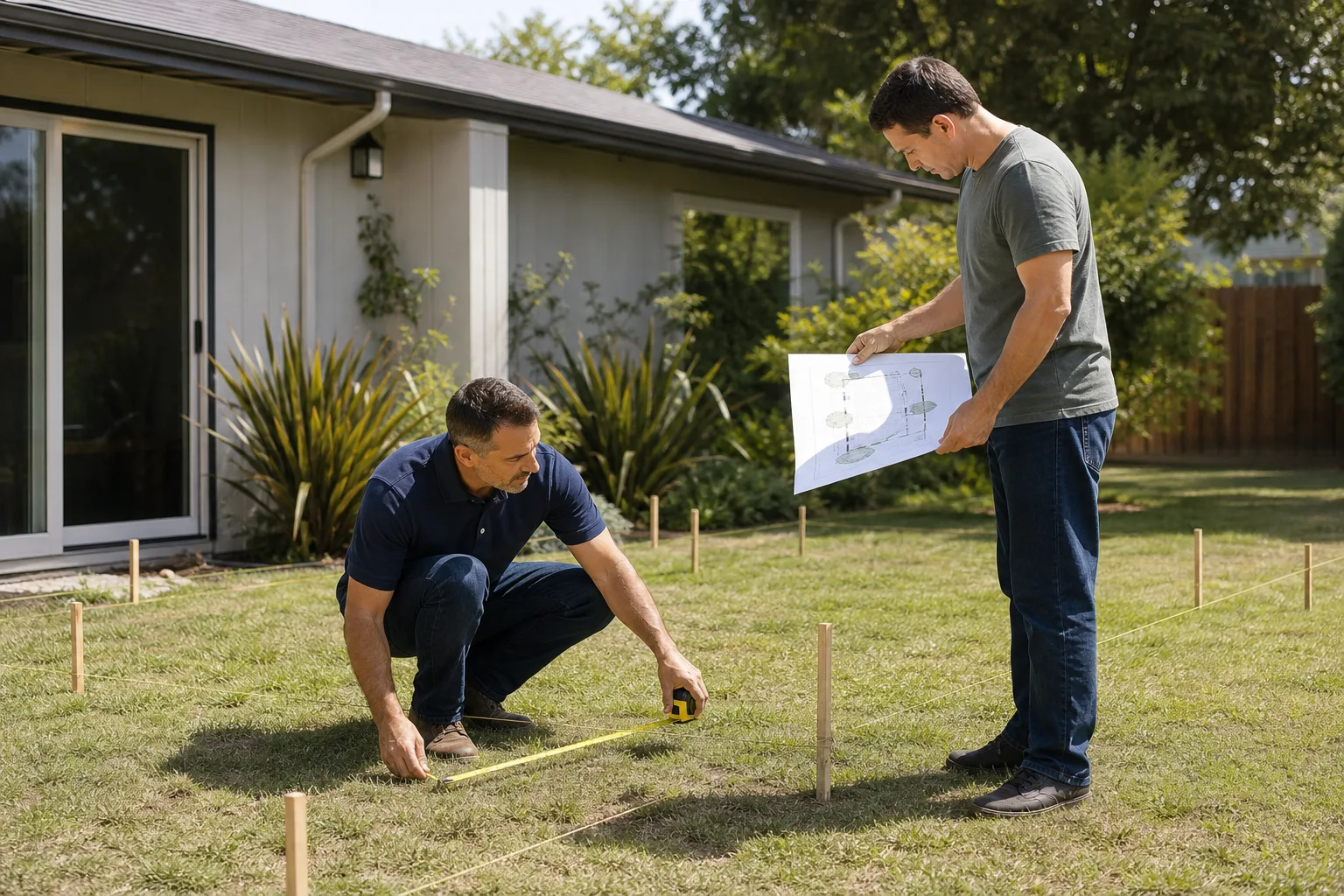
Before a licensed contractor bids your utility runs, you can hand-dig shallow exploratory trenches (typically 12 – 18 inches deep, well away from any marked line) to confirm where the existing water, sewer, and electrical stubs actually sit on your lot. This is information-gathering, not installation. It lets your contractor bid the run accurately instead of pricing worst-case excavation. On a 500-foot run, an accurate bid versus a padded bid can differ by $2,000 – $4,000. Hand-digging the exploratory trench yourself is the cheapest due diligence in the project.
3. Vegetation removal that doesn’t involve a licensed arborist
Cutting back oleander, removing low shrubs, and clearing dead brush is DIY-eligible. If a tree is over 20 feet, near a power line, or protected under a Henderson HOA landscape covenant, stop. A licensed arborist handles the removal, and most HOAs in Seven Hills and MacDonald Ranch require written approval before any tree comes down. Clearing brush: your call. Felling trees near structures or utilities: not your call.
The 18-Inch Rule and the NV811 Locate Ticket Problem
Any work within 18 inches of an existing buried utility line requires a licensed contractor with active dig-safe coordination. This is the hard professional boundary most DIY owners cross without realizing it. The line doesn’t have to be marked at the surface. It only has to be there.
Here’s the Henderson-specific issue: NV811 locate tickets expire in 15 days. The utility companies mark the buried lines, and the marks are valid for 15 calendar days from the ticket date. If your trench work extends past that window, the ticket expires and any excavation you perform is uncoordinated, whether or not the marks are still visible in the dirt. DIY owners routinely miss this. The pipe is still painted orange on day 20, so they keep digging, and they’re now excavating an unlocated utility. If they hit a gas line or a fiber run, the liability lands on them, and their homeowner’s policy almost certainly excludes unlocated-utility damage from an unpermitted excavation.
Every licensed contractor on the job renews the ticket as required. If you’re performing any portion of trenching within 18 inches of a live line, our team renews the NV811 ticket on schedule and keeps the coordination record in your project file, so the inspection has documentation showing every dig was properly permitted and located.
Why the Concrete Pad Is the Most Misunderstood DIY Task
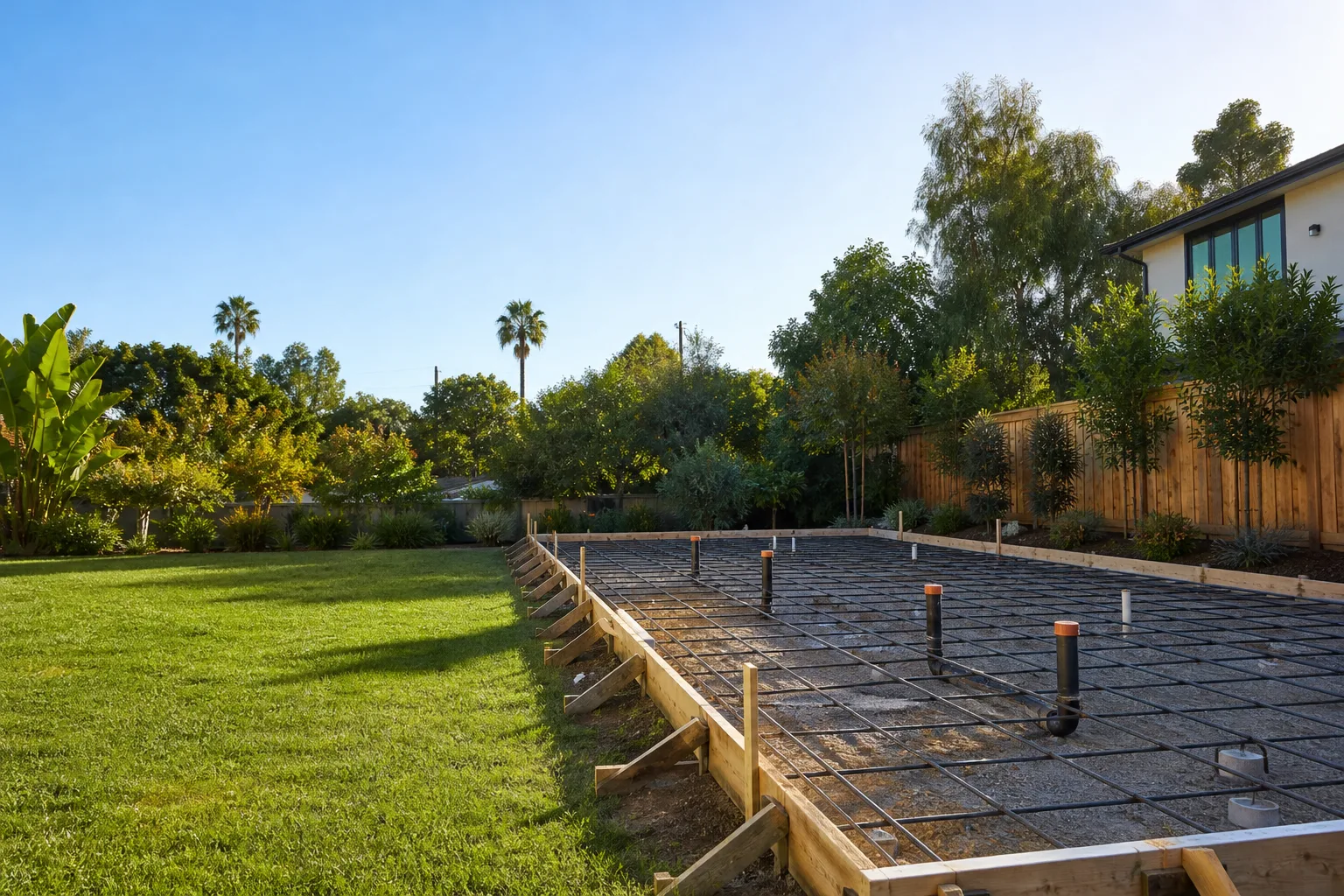
The pad pour is technically DIY-eligible. Technically. Here’s the part that catches people: the rebar inspection must pass before the pour. The inspector visits after the formwork and rebar are set, checks spacing, cover, and tie method against the structural notes in the permit set, and either signs off or doesn’t. If the inspector doesn’t sign off, the pour doesn’t happen that day. The schedule slips, and there’s no negotiating with the inspector.
The second trap is the mix design. Every ADU structural set specifies a minimum concrete compressive strength (commonly 2,500 – 3,000 psi for a slab-on-grade pad, sometimes higher for a stem-wall foundation), and the batch ticket from the ready-mix supplier has to show that design was delivered. If the batch comes in under spec, the pad gets demolished and repoured. The inspector reads the batch ticket. If the numbers don’t match the structural notes, the pour is rejected, and the cost of demolition and repour is all yours.
What this means practically: a homeowner who knows a concrete crew, trusts the batch ticket process, and has a clear schedule window can save $800 – $1,500 on the pad. A homeowner who’s never coordinated a rebar inspection before is risking a $3,000 – $5,000 repour on a task that a licensed crew handles for roughly the same money as their markup.
Gas Line Extensions: No Owner-Builder Exception in Nevada
Nevada requires a licensed contractor for any gas line extension. There is no owner-builder exception, regardless of run length. A 6-foot extension to feed a gas range in your ADU is the same licensing requirement as a 60-foot run to a pool heater. This is the clearest “you cannot do this yourself” category on the entire site-prep list.
The utility side is where it really locks in. Southwest Gas will not perform the pressure acceptance test on owner-installed pipe. The pressure test is a required step to prove the line holds the specified pressure without leaking. It’s performed by a licensed contractor with the appropriate pressure gauge setup and documentation, and Southwest Gas won’t sign off on the meter set until that test record is on file. A homeowner who installs the pipe themselves cannot get Southwest Gas to test it, which means they cannot get gas service to the ADU. The pipe is in the ground. The service still won’t turn on.
Under the Ellery ADU Studio Henderson home umbrella, every gas run on our ADU projects is performed by a licensed gas contractor with the pressure test documented in the project file, so Southwest Gas energizes on the first request.
The Conduit Trench: Where DIY Labor Saves $800 – $1,400
This is the one utility task where licensed electricians routinely let homeowners do the physical labor without affecting the inspection. Dig the trench for the underground conduit run between the main panel and the ADU sub-panel. Backfill it after the conduit inspection passes. The electrician installs the conduit, pulls the wire, and handles the terminations at both ends. You handle the shovel work.
The savings are real: trenching and backfilling a 60 – 120 foot conduit run typically costs $800 – $1,400 in labor. There’s no code issue with you performing the excavation as long as the trench meets depth and width requirements in the permit set (commonly 18 inches minimum cover for rigid conduit, more if the run crosses a driveway), and the trench is properly bedded with sand before the conduit goes in. The conduit inspection is on the conduit and wire, not the trench digger. Your electrician still pulls the permit and performs the licensed work. You just moved the dirt.
- Confirm trench depth and route against the permit set before digging. Depth varies by conduit type and whether the run crosses pavement.
- Renew the NV811 ticket if the original locate has expired (15 days).
- Dig the trench to the specified depth and width.
- Bed the trench with sand before the electrician installs conduit.
- Call for conduit inspection after installation, before backfill.
- Backfill after inspection passes and the photo record is captured.
The Meter Socket and Utility Energization Trap
Nevada allows owner-builders to perform electrical rough-in. The building permit will pass inspection with an owner-installed meter socket. NV Energy will still refuse to energize the meter. This is the single most expensive DIY mistake we see on Henderson ADU projects, and it usually surfaces after the owner has already spent $4,000 – $6,000 on rough-in and inspection fees.
The reason is straightforward once you see it: NV Energy’s service connection standards require the meter socket installation to be performed by a licensed electrical contractor whose license is on record with the utility. The utility doesn’t care what the building department passed. It cares who installed the socket. If the answer isn’t a licensed electrician, the service doesn’t turn on until a licensed electrician removes the owner-installed socket, installs a new one, and the utility re-inspects.
What that looks like in practice: roughly $1,200 – $2,000 in rework, plus a schedule slip of four to eight weeks waiting on the utility’s re-inspection queue. Under Haven Clause 1, our projects quote the meter socket installation as a line item before work starts, performed by a licensed electrician with the utility’s licensing record already on file, so there’s no rework on the back end.
Sewer and Water Tie-Ins in Henderson’s Older Neighborhoods
Sewer and water tie-ins to the existing service are licensed-plumber work, no exception. The part Henderson homeowners sometimes miss is that the tie-in point itself varies by neighborhood. In older Henderson properties near Water Street and along the Lake Mead corridor, the existing lateral may be clay or cast iron, which changes the connection method and often requires a partial line replacement rather than a direct tie-in. Newer builds in Green Valley and Inspirada are typically PVC with a clean connection point.
The other variable is the Clark County Water Reclamation District’s inspection requirements. The tie-in has to be inspected before backfill, and the documentation has to show the connection was performed by a licensed plumber with the appropriate permit. If you’re coordinating your own site prep, the sewer lateral inspection is the one you most often see scheduled wrong, because the backfill happens before the inspection, and then the trench has to be re-excavated. Re-excavating a backfilled sewer trench costs more than the inspection fee every time.
What Inspectors Actually Check and How to Prepare
Inspection sequences on Henderson ADU site prep follow a predictable order, and knowing it saves you from re-excavation and reschedule fees. The inspections that apply across most site-prep scopes:
- Utility locate verification (NV811 ticket active on inspection date, every time)
- Foundation excavation and rebar (before concrete pour, against structural notes)
- Conduit and electrical rough-in (before backfill for underground runs)
- Gas line pressure test (Southwest Gas acceptance record on file before meter set)
- Sewer lateral tie-in (before backfill, with plumber’s license documented)
- Final electrical and utility energization (licensed contractor of record required for NV Energy meter socket)
Every inspection above requires a record of who performed the work and what documentation exists. Under Haven Clause 5 (No Surprises), our scope is locked at signing, and the inspection sequence is scheduled into the project calendar so nothing gets backfilled before its inspection passes. A documented photo record on every visit means the inspector sees what was found, not a summary of what was done.
Common Mistakes to Avoid
- Skipping the survey stake before grading. Grading before the survey stake is set disturbs the reference elevation the structural engineer’s pad spec assumes, and the rework is a paid re-survey plus a re-grade. The order is clear first, survey second.
- Letting the NV811 ticket expire mid-dig. The ticket is 15 days. If your trench work crosses that window, the excavation is uncoordinated. If you hit a line on day 16, your insurance carrier has grounds to deny the claim.
- Installing the meter socket yourself. The building inspection passes. NV Energy refuses to energize. The rework runs $1,200 – $2,000 and four to eight weeks of schedule slip you can’t get back.
- Pouring the pad without the rebar inspection. The inspector doesn’t negotiate, and the pour that went in without an inspection passes into demolition, not into service.
- Backfilling the sewer trench before the tie-in inspection. Re-excavating a backfilled trench costs more than the inspection fee on every job where this happens in Henderson.
- Assuming an owner-builder gas line is legal because the permit covers it. Southwest Gas won’t perform the pressure acceptance test on owner-installed pipe, so the meter never sets regardless of the permit.
- Felling a protected tree without HOA sign-off. Seven Hills and MacDonald Ranch HOAs require written landscape approval, and a felled tree without approval can trigger a covenant violation that delays the whole site-prep sign-off.
When to Call a Professional
Call a licensed contractor when the scope involves any work within 18 inches of a live utility, any gas line extension regardless of length, the meter socket installation, the rebar-and-pour inspection sequence on the pad, the sewer lateral tie-in, the conduit installation and wire pull, or the final utility energization. Those seven categories account for the majority of site-prep cost, and every one of them either fails inspection, gets rejected by the utility, or creates exclusion-level liability if performed by an owner-builder in Henderson. If your scope is confined to clearing, grading before the survey stake, exploratory trenching, or vegetation removal below arborist territory, you’re in the DIY-eligible zone. If it touches any of the seven, it doesn’t stay in the DIY zone without documentation. Ellery ADU Studio Henderson offers free estimates in Henderson and a free second opinion on any written estimate you already have in hand. Call (833) 632-6140.
Frequently Asked Questions
You can perform electrical rough-in as an owner-builder and pass the building inspection, but NV Energy will not energize a new meter socket that wasn’t installed by a licensed electrician. The work that actually turns the lights on requires a licensed contractor, regardless of permit status. Call (833) 632-6140 to have our team quote the electrical scope as a line item before work starts.
An NV811 locate ticket is valid for 15 calendar days from the ticket date. If your excavation extends past that window, the marks in the dirt don’t renew the ticket, and any dig after day 15 is uncoordinated. Renew before you keep digging. Call us for a second opinion on your locate schedule.
No. Nevada requires a licensed gas contractor for any gas line extension, regardless of run length, and Southwest Gas will not perform the pressure acceptance test on owner-installed pipe. Without that test record, the meter won’t set. Call (833) 632-6140 for a written quote on the gas scope.
Utility scope on a Henderson ADU typically runs $12,000 – $28,000 depending on distance from the main panel, gas line length, and whether the existing sewer lateral needs replacement. Trenching and backfill alone, if you do it yourself, saves $800 – $1,400 on the electrical run. Every Ellery project quotes the utility scope with a written price before any work begins, per Haven Clause 1. Call (833) 632-6140 for an exact written quote on your lot.
In most cases, no. If the NV811 ticket expired before the strike, or if the excavation was unpermitted, the carrier has grounds to deny the claim, and unlocated-utility damage sits in an exclusion most Henderson homeowner policies carry. The safest assumption is that you’re carrying the loss yourself.
Yes, Clark County allows owner-builder permits for ADU construction, but the permit doesn’t override the licensing requirements specific to gas, meter socket installation, and utility energization. An owner-builder can pull the permit and still be unable to get gas or electrical service turned on without a licensed contractor’s work. Call (833) 632-6140 to understand what your specific scope requires.
The Bottom Line
Three site-prep tasks are safe to do yourself on a Henderson ADU: clearing and grading the pad area before the survey stake is set, hand-digging exploratory trenches to locate existing utilities before your contractor bids, and vegetation removal that doesn’t touch a protected tree. Everything else requires a licensed contractor, and the failure modes are specific: gas that Southwest Gas won’t test, a meter socket NV Energy won’t energize, a pad that gets demolished if it doesn’t hit the permit set’s mix design, a locate ticket that expires in 15 days, and a trench that costs more to re-excavate than to inspect correctly. Our technicians have up to 11 years of experience across these scopes in Henderson. Our prefab and modular work coordinates systems from Cover, Dvele, and Mighty Buildings within the same single contract, including the site prep and utility scope. You can read more about ADU Design & Permitting in Henderson, Garage Conversion ADU in Henderson, and New Detached ADU in Henderson to see how the site-prep scope fits each project type.
Ready to know what your site prep actually costs? Call Ellery ADU Studio Henderson at (833) 632-6140 for a free estimate. A live person answers calls 24/7, and every project is quoted at a written price before work begins. If you’ve already received an estimate from another contractor, we’ll review it free and tell you exactly what’s missing from the utility scope.
Written by the team at Ellery ADU Studio Henderson.